
The Undefined War
Nukes and missiles and regime change, oh my!

In 1953, the CIA overthrew Iran’s democratically elected prime minister, Mohammad Mossadegh, and installed a pliant shah – king – in his place because we didn’t like how the democratic leader treated us.

Twenty-six years later, revolutionary students stormed our embassy, took fifty-two Americans hostage for 444 days, and opened four decades of mutual hostility that we’re still paying for today.
Our regime change – perhaps the “original sin” in US-Iran relations – “worked.”
We’ve been here before.
These are my first, broad thoughts I’m still processing on a war that’s just starting. I’m not an Iran expert – but I did study diplomacy and conflict in Israel, sitting in classes learning about nuclear deterrence, US foreign policy, and the Middle East from ambassadors and policymakers. More relevantly, if you’ve read anything I’ve written, you know I don’t retreat into tribal corners. I’m capable of holding conflicting thoughts without needing to fit them on a bumper sticker (hence the length of this piece 🙃)…which is appropriate, because almost nothing I think about this fits neatly into a “camp.” I have real concerns and real moments of satisfaction about what happened this week. Both are genuine and neither cancels the other out. I have no clean conclusion here – and I’d be suspicious of anyone who does.
As an American, I can’t help but be a little smug and happy about this. It’s been a long time coming: the 1979 embassy seizure and hostage crisis; the Eagle Claw debacle; the Beirut embassy bombing; the direct support of the Iraqi insurgency in general: specifically the hundreds of dead Americans at the hands of EFPs and IRGC weaponry in Iraq; the constant saber rattling in the Strait of Hormuz and everything in between – to say nothing of all the military aid they’ve sent to Russia to brutalize Ukraine. In a purely nationalistic, bloodlusty sense, it feels righteous to finally be dropping the pretense and bringing the hammer down on Iran in such a massive way.
By its own merits, Iran’s brutal regime deserves to be ignominiously sent to the dustbin of history. There should be no sadness for the deaths of Ayatollah Ali Khamenei or Mahmoud Ahmadinejad or the IRGC leadership. From domestic massacres and executions to subjugation of women and suppression of votes to mass arrests and brutal crackdowns on protests, you won’t find me or many others eulogizing the Iranian regime; I’ve been happy to see protestors celebrating in the streets, pulling down statues and cheering.
As a former active-duty soldier, I can’t help but be impressed by the operation. Reading about the air strikes in broad daylight…hearing about the intelligence efforts to identify the targets…seeing an Iranian ship blow up through a submarine’s periscope – the timing, the synchronization, and just the straight-up effectiveness of this operation makes you stand up a little straighter. Whatever else I think about this week, as a former operations planner, I have a hint of what it costs to plan and execute something like that – and it’s nothing short of impressive to see it executed at this level.
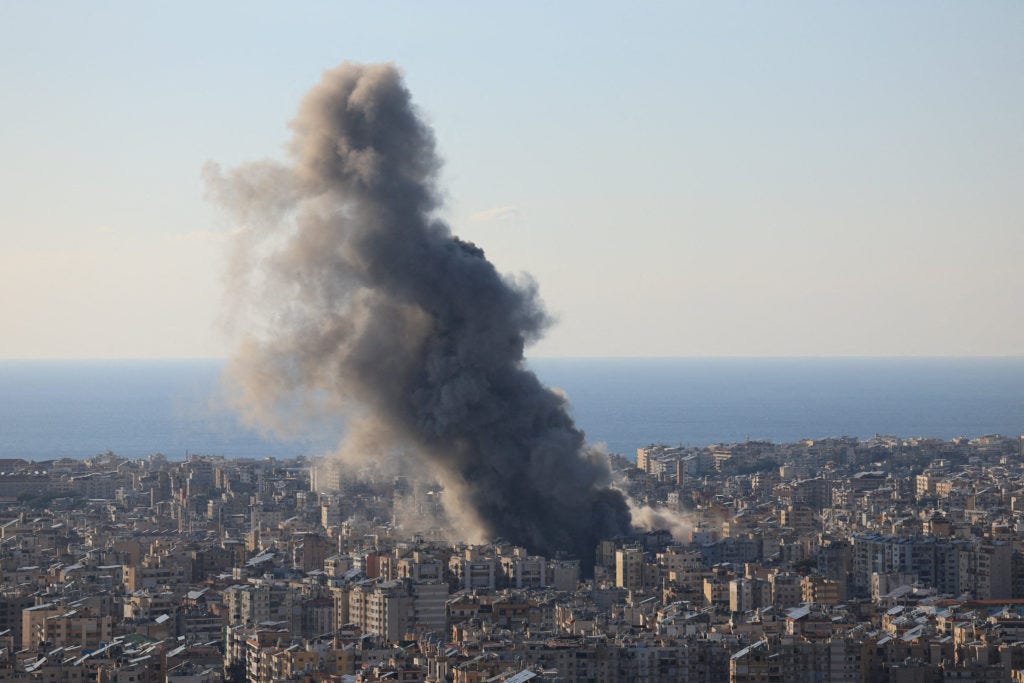
But bigger, smarter parts of me are also disturbed. Just because we’re good at fighting and winning battles doesn’t mean we’re good at fighting wars.
And just because we can doesn’t mean we should.
Almost everything worth feeling good about this week comes with a huge asterisk.
Toppling the Iranian regime? We did that in 1953 – and have spent the next seventy-plus years paying for it (look up Kermit Roosevelt for some fun bedtime reading).
Liberated crowds celebrating in the streets? Iraqis cheered when Saddam’s statue came down too – right before a decade of insurgency that killed 4,400 Americans.
We should know how these things end.
As an American citizen, it’s these concerns that far outweigh my satisficed bloodlust.
Why are we there?
Because President Trump said he wants to make sure that “somebody that is rational and sane” is in charge in Iran and that current leaders are “unacceptable” to him. But regime change is not a goal of the operation according to his Vice President, Secretary of State, and Secretary of Defense.
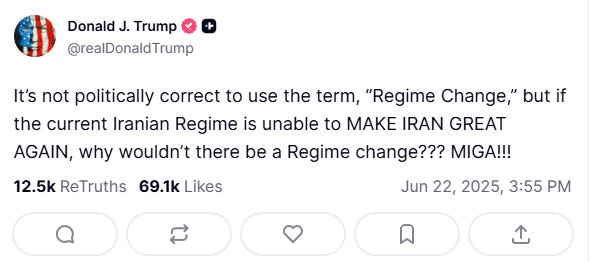
Because Trump wants freedom for the Iranian people and to make Iran "economically bigger, better, and stronger than ever before.” But this will be “no nation building quagmire” according to Defense Secretary Hegseth.
Because Trump said their ballistic missiles could “soon” threaten our homeland. But Trump’s own intelligence agency said Iran might be able to threaten us with ballistic missiles…in 2035.
Because they were “a week away” from being able to make a nuclear bomb…with the same nuclear capabilities that Trump confidently and vociferously insisted were “completely and totally obliterated” just months ago.
Because we knew that Israel would strike first and then Iran would hit us. No, definitely not that – “The president determined we were not going to get hit first.”
So why are we there? The answer depends on the time of day – which says something important about whether anyone actually knows.
Well, perhaps someone does. In fact, Trump himself answered this question years ago with characteristic bluntness. In 2013, he tweeted: “Now that Obama’s poll numbers are in tailspin – watch for him to launch a strike in Libya or Iran. He is desperate.”
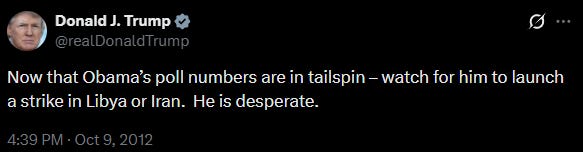
He may have had a point then. And maybe the tail is just wagging the dog now, too.
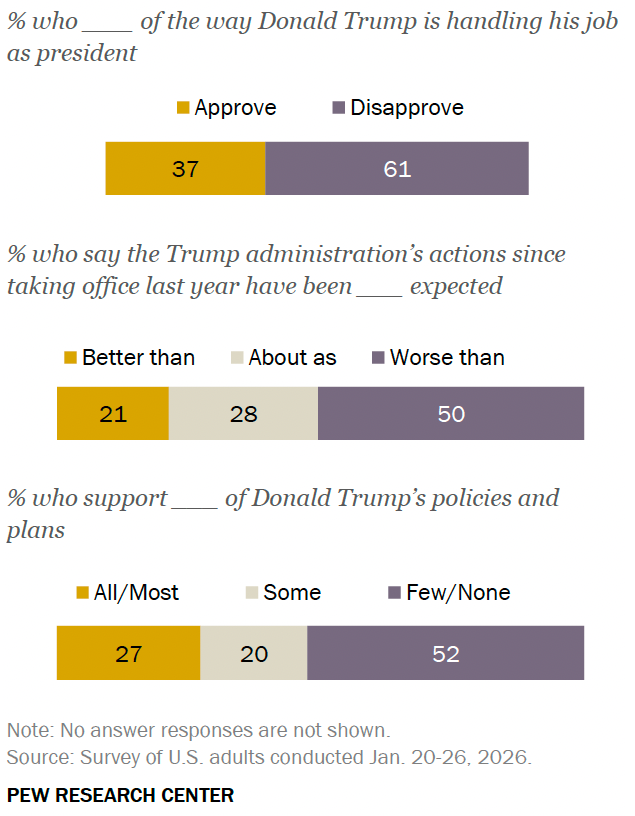
Normally we would have seen the president delivering a solemn address from the Oval Office by now, explaining what has happened, why we are doing it, and what’s to come.
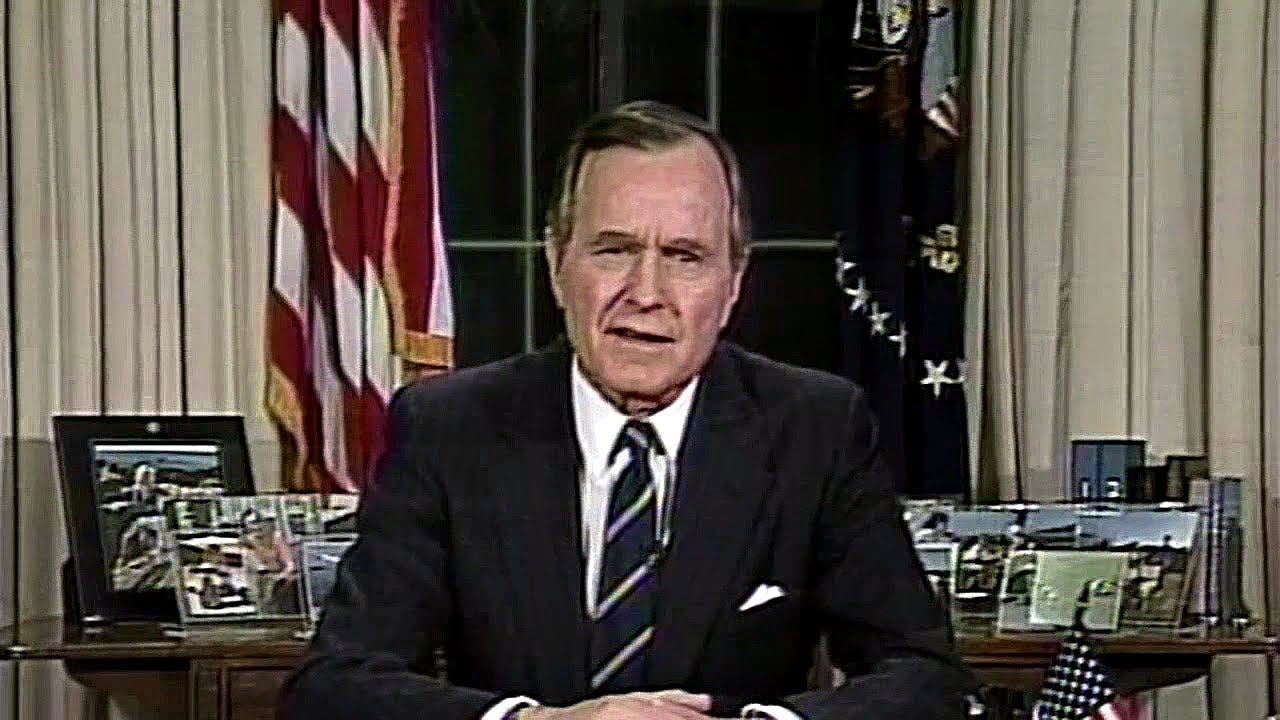
No such luck this time around. Instead, the president released a short video in the middle of the night on Temu Twitter and has had a few press conferences here and there.
Some of these questions would have been fleshed out and answered to some degree if we at least made an effort to follow a constitutional process here. Article I of the Constitution is crystal clear that only Congress has the authority to declare war.
World War II was the last formally declared war. Going back to John Adams and the Quasi-Wars, military actions have been variously authorized by Congress, blessed by the UN or NATO, or executed entirely on the president’s own rogue say so.
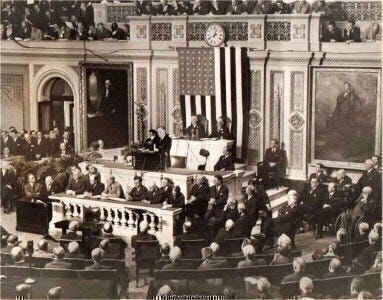
Obviously this has been a point of contention over the years – mostly for whichever party is out of power.
Of course, congressional approval does not equal success. The war in Afghanistan was conducted under a congressional Authorization for Use of Military Force (AUMF). In the aftermath of 9/11, the AUMF underwent nearly no debate in a wounded and angry Congress, passing with only one dissenting vote. The subsequent war there was tactically brilliant but often operationally adrift. The AUMF seemingly neatly and narrowly defined the strategic aim in one sentence – in part “to prevent any future acts of international terrorism against the United States.”
But how neat and narrow was that definition in practice? Well, after 20 years of war and 20,000+ dead or wounded, we still couldn’t define the goal – nonetheless accomplish it.
The Iraq AUMF was thoroughly and hotly debated in Congress and at the UN, but that debate did not develop clear war aims.
We all know how that one turned out, too.
Nor does congressional involvement mean indecision and failure. Desert Storm was also conducted under an AUMF. It was tactically and operationally brilliant, but its true brilliance was in its strategic success – an effort with clearly defined goals and, most admirably, a deliberate decision to quit after achieving those goals and resist the siren call of mission creep. That decision to stop seems even more admirable and brilliant than it was 35 years ago.
But this time around, we don’t have the benefit of any of that debate or discussion of strategic ends or goals. We don’t know where the finish line is – because we don’t even know why we’re running the race or what the course looks like.
Of course it’s messy and inconvenient to have these debates in an unwieldy legislature known for plodding bloviations. The wisdom of the founding fathers in giving Congress the responsibility to declare war is that war should be something that is deliberated over, debated, thought out, and rehashed.
It should be something that we are wary and hesitant to jump into. It should be something that we take seriously. It should be something where we plan how we’re going to do it, when we’re going to do it, and – perhaps most importantly – when we’re going to stop doing it.
Instead, as a country sending our sons and daughters to die in yet another war, we are left to read the tea leaves to divine reasons as to why we are spending all this blood and treasure. With no formal declaration or authorization, we’re left to listen to “woke” Ivy Leaguers like Hegseth and Vance to try and decipher the purpose of all this.
When it comes to Congress, I’ve made a series of predictions that, in hindsight, seem as bold as predicting Elton John’s sexual preferences: they won’t hold Trump accountable. It’s as close to a sure bet as you can get in politics, and if I’m ever proven wrong, I’ll gladly pay out that loss.
Of course, there’s always a rally-around-the-flag effect when a president launches military operations. But combine that with congressional impotence and obsequiousness, and you get Senator Ron Johnson.
In 2011, watching President Obama bomb Libya, Johnson said: “I kind of like following the Constitution. It is Congress’ duty and responsibility to declare war. And I think at a minimum, the administration should’ve come to Congress to get approval.”
This week, an older, wiser Ron Johnson opined that having 535 members as commanders in chief was simply unworkable. He then went on to say that it would be dangerous for the president to even notify Congress of military actions.
I guess the Constitution is only useful as a tool to bludgeon the last guy over the head with.
So here we are. What’s next?
Overthrowing the Iranian regime in 1953 came back to bite us, so why might this time be any different? How did overthrowing Saddam Hussein go? What happened in the power vacuum of post-Mubarak Egypt, post-Qaddafi Libya, and post-Assad Syria? What came out of the lawlessness of Afghanistan? (Reminder: nothing good, lots of terrorism and death)
We’ve been clearly told that the US does not do nation building. Which, to be fair, is probably right and probably smart.
We’ve been given timeframes for the operation, but no actual objectives for the operation.
What is the timeframe, you may ask? Well, it depends on when you ask. We’ve been told we’ll be there less than 4 weeks. Or maybe 4-6 weeks. Or, according to Trump, “whatever it takes…whatever the time is, it’s okay.”
So what are we actually trying to accomplish in that time? It certainly seems – and Trump has confirmed – that we’re targeting the Iranian regime. But to what end?
Regime change is a viable and, in some circumstances, reasonable military goal – although it didn’t work well for us with Karzai in Afghanistan or Allawi in Iraq or Pahlavi in Iran. If that is our goal here, are we committed to making that happen and – more importantly – are we ready for the popular violent backlash to an American puppet regime (AKA 1979 Iran redux)?
If our goal is merely regime decapitation, are we satisfied with the next layer of the regime taking over? Instead of Khamenei as ayatollah, are we cool with his son stepping up? Instead of the last IRGC commander, are we good with “The Butcher’s Apprentice” being in charge? Do we really expect them to be nicer, gentler dictators than their “very wicked, radical” predecessors?
We have already achieved regime decapitation and the war continues, so this obviously wasn’t the only goal of the attacks.
Are we now going for regime decimation? Do we just tell the IRGC there’s no Iranian regime anymore and hope they become farmers instead of warlords and mercenaries? We tried this in Iraq; we quickly decapitated Hussein’s regime, then spent a decade fighting the insurgency it became. The Soviets did the same thing in Afghanistan in 1979 – within 15 years, the Taliban was hailed as the only group that could restore order. We all know how that one ended.
We’ve also been told that we will fight until “Iran can no longer pose a threat to the United States of America.” Look at the footage from the 1979 embassy seizure in Tehran. You won’t see many uniformed soldiers in those videos; it was civilian students who took fifty-two Americans hostage for 444 days.
No military operation can prevent Iran from ever posing a threat. Trump has said that “UNCONDITIONAL SURRENDER” is the only way to guarantee that Iran never threatens us again. Are we prepared to conquer and subjugate the entire country to achieve that?
The last unconditional surrender came after two nuclear bombs were dropped. Is that where we’re headed? Do we just completely eliminate Iran and its people to accomplish our goal?
If recent history is any indication, the most likely answer to “what’s next?” is a shrug and – despite Hegseth’s protestations to the contrary – an indefinite quagmire.
I’m not going to pretend I can fully map out this bottomless rabbit hole, but there is nowhere more balkanized in the world right now than this region.
Iran is the main belligerent, but Lebanon and Iraqi militia proxies are getting involved.
China is resupplying Iran with military aid. Russia is providing intelligence for Iranian strikes on US targets. Sri Lanka is providing safe harbor for an Iranian helicopter ship.
With the conflict metastasizing to Cyprus and Turkey, there’s a very real risk of damage in NATO territory triggering Article 5.
Ironically, Trump has unwittingly cornered himself onto Ukraine’s side – with Russia weighing in for Iran, Ukraine is de facto promoted to erstwhile “enemy-of-my-enemy-is-my-friend” status.
The next logical spread would be to Iranian client states in Africa. And you don’t need to squint too hard to imagine an anti-US axis welcoming Cuba and Venezuela into the fold.
Of course international law isn’t real, but we are certainly rushing toward a nakedly Thrasymachean world order where justice is “nothing other than the advantage of the stronger.” Without even a fig leaf of congressional legitimacy (to say nothing of NATO or the UN), it wouldn’t be surprising to see our precedent here (and in Venezuela) justify a future attack against us. Having cut off most of our traditional allies, it’s not completely fantastical to imagine the anti-US forces of the world seizing an opportunity to attack a weakened, isolated US. Are we ready to swallow an AI/drone/cyber attack from China because of some allegedly perceived threat?
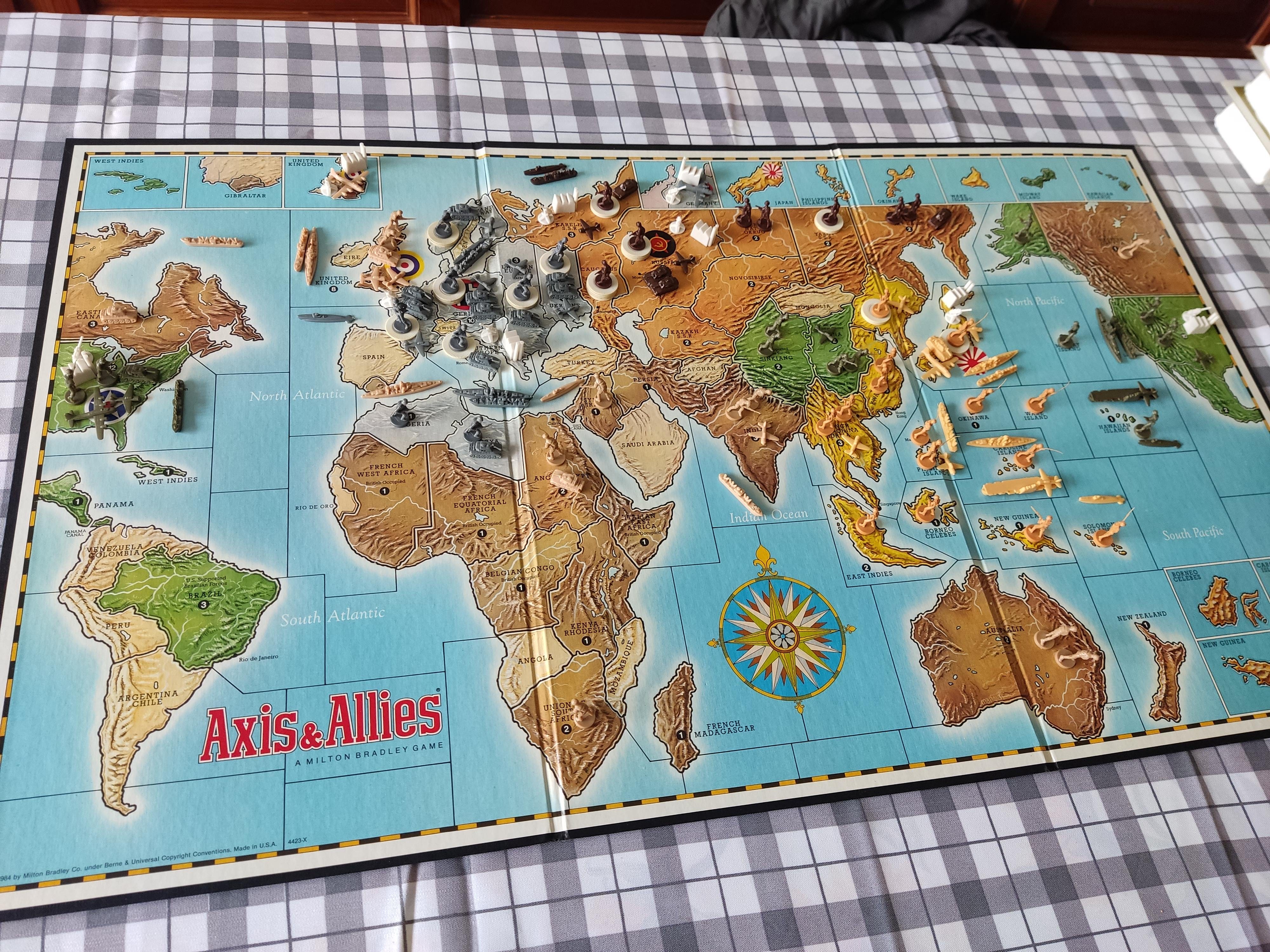
Predicting the outbreak of World War III is about as useful as crying wolf, but I do think this is probably the most ominous the gameboard has looked in my lifetime.
We started this campaign without knowing why and we don’t have a plan for what comes next. We’ve done this before – but I thought those were supposed to be lessons learned, not practice rounds.
There’s lots more swirling in my head (Call of Duty hype videos, SECDEF glossing over US casualties, complaining about media coverage of our fallen soldiers, etc. to name a few), but I’m going to stop here.
I’ll admit, I almost miss the months spent beating war drums on talk shows. The Secretary of State eviscerating his credibility at the UN. Then finally just going somewhere under false pretenses. At least we pretended to go through the motions then. It seems so quaint now.
Ah, the good ol’ days.
A common sense approach grounded in history, expertise and common sense. One of the brightest essays I have read on this topic. I am saddened by this administration and this move toward another war in the ME. “He knows not what he has done.” Well done Micah! I am proud to know you. Keep writing.
WOW! I would expect nothing less from
you knowing your background. I am old but know we will get this country back on the right path. That is where individuals of your caliber comes in. Keep doing your thing for all of our generations to come.
G Reed